Meyers Permanent Aquatic Invasive Species Inspection Station
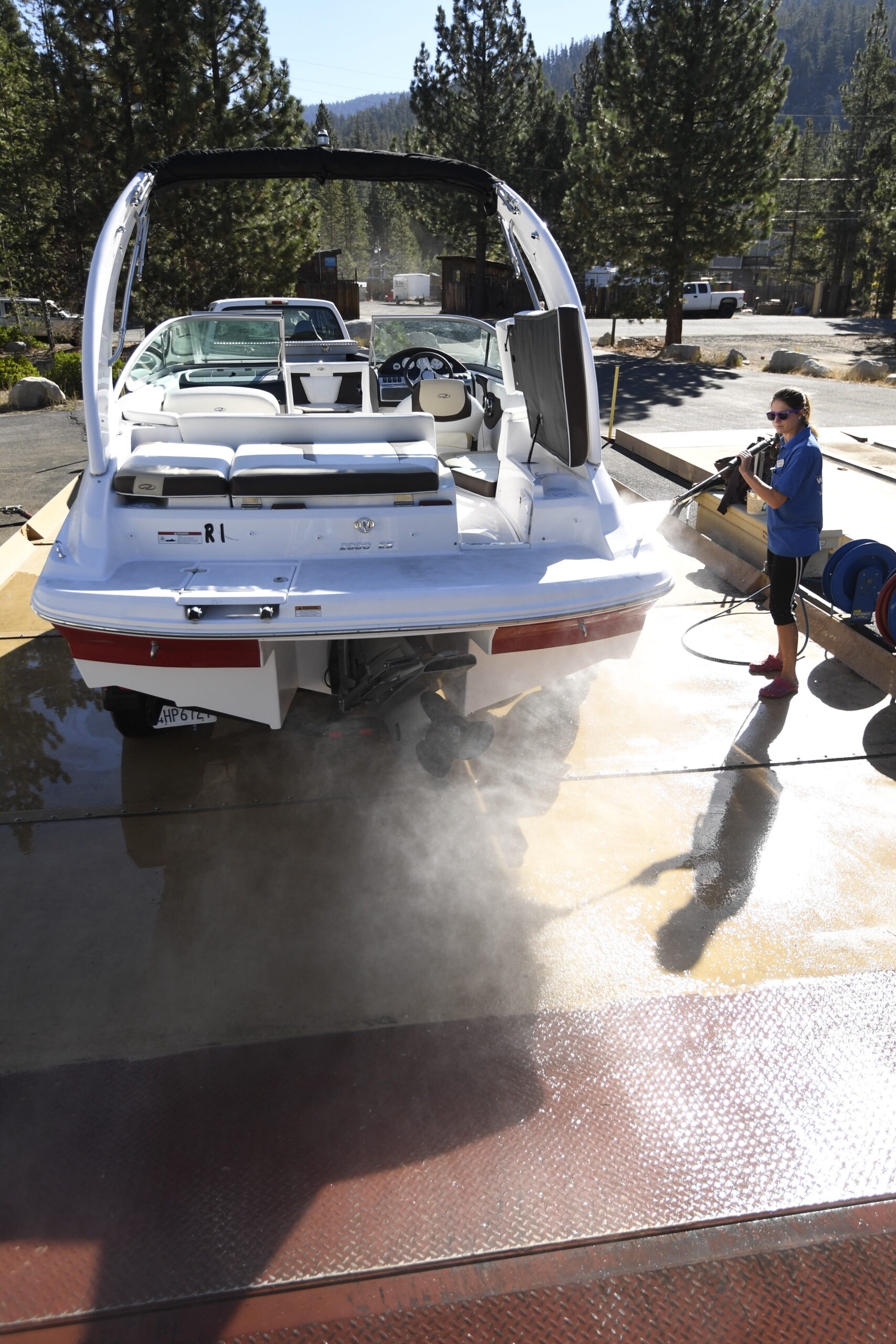
Tahoe Regional Planning Agency and the Tahoe Resource Conservation District are working together to meet the long-term needs of the Lake Tahoe Aquatic Invasive Species Program by securing permanent locations for watercraft inspection stations around the lake. These agencies are collaborating with El Dorado County and the California Tahoe Conservancy to pursue a permanent home for the watercraft inspection station in Meyers, California where approximately 2,000 boats are inspected every year to protect Lake Tahoe from aquatic invaders.
Protection from the Latest Threat

Building on Program Success
Watercraft are one of the leading vectors for spreading aquatic invasive species (AIS) into new waterways. AIS negatively impact aesthetics, recreation, the economy, native, sport and local species, and water quality and can increase algae growth that contributes to the decline of Lake Tahoe’s famous water clarity. Mandatory inspections stop aquatic invasive species before they enter the water.
Since the watercraft inspection program began in 2008, more than 118,000 vessels have been inspected at seasonal inspection stations around Lake Tahoe to help boaters get on the water safely and efficiently. There are typically three stations operating near key basin entry points during the boating season, with the Meyers station serving the southern portion of the Tahoe Basin.
Proposed Permanent Location

The proposed new location is on four California Tahoe Conservancy asset land parcels on Pomo Street near the junction of State Route 89 and U.S. Highway 50. The site provides the opportunity for better facilities for watercraft inspectors and the public: it has queuing space for at least 14 boats, which essentially eliminates the potential for clogging public roadways. It’s significantly safer for inspectors and the public as inspections would not need to occur on the roadway, and reduces the work needed for annual setup and breakdown. A permanent facility also provides the opportunity for onsite workforce housing for watercraft inspectors in summer and snow removal staff in winter.
FAQ
Why does the Meyers watercraft inspection station need a new home?
Watercraft inspections are proven to be extremely effective in preventing the introduction of new aquatic invasive species (AIS), such as quagga mussels and golden mussels, into Lake Tahoe. This reduces the threat of devasting impacts from AIS to the Lake Tahoe Region.
Permanent inspection stations have been a priority for the AIS Program since its inception in 2008. The current Meyers watercraft inspection station is a temporary location that is privately owned and leased annually, which does not provide the long-term reliability or stability the AIS Program requires. The current site is also constrained and does not provide the necessary queuing, storage, and operational space for sustained operations of the Meyers location. This includes the need for year-round inspection operations, as boats can launch into Lake Tahoe throughout the year.
Why now?
In 2021, the AIS Program and Tahoe Regional Planning Agency were fortunate to receive funding through the Bipartisan Infrastructure Law to identify and secure permanent locations. The AIS Program is one of only a handful of natural resource focused programs across the country that received this funding. In addition, the California Tahoe Conservancy, through its Asset Land Program, has appropriate land available for development that meets the needs of the program.
Why must it be on publicly owned parcels?
Eliminating the cost and uncertainty of leasing private land is an important element to a sustainable long-term inspection station in Meyers. Uncertainty includes change in ownership or the market that leads to new lease terms that are very challenging for public agencies to manage. In addition, inspecting and eradicating aquatic invasive species is inherently dynamic and leads to changes in operations and facilities that are not guaranteed under contractual lease agreement. Lastly, by placing the inspection station on land already publicly held it eliminates the potential from additional parcels being removed from the local property tax base.
Why is the proposed site ideal?
The proposed site is ideal for a variety of reasons. The proposed site is publicly owned by the California Tahoe Conservancy and has been deemed “asset lands” which is developable, nonsensitive land that is located at the corner of Highway 50 and State Route 89 in Meyers Town Center – nearby the current temporary watercraft inspection station. The proposed site does not have to be purchased but is proposed to be acquired through a land exchange between the Conservancy and El Dorado County with the County eventually owning the site.
At the current temporary site, work often occurs in public roadways during busy periods due to site constraints. The proposed site would provide a safer space for inspectors to work as it provides adequate space to accommodate on site queuing, removing vehicle trailer combinations from local roadways. For example, the proposed site is designed for approximately 14 tow vehicles and trailers to fit on-site, while the current site has room for only three.
The proposed site can also accommodate the necessary infrastructure to meet the needs of the AIS Program today and into the future, including the administrative, operational, and storage needs.
Have you investigated other publicly owned sites nearby as alternative options for the Meyers watercraft inspection station?
Yes, other public lands owned by the California Tahoe Conservancy, U.S. Forest Service, Lake Tahoe Basin Management Unit, and El Dorado County were investigated.
However, none were able to meet the criteria necessary to house the watercraft inspection station including on-site queuing for a minimum of twelve 50 foot long vehicle trailer combinations, internal and external turning radius’ associated with a 50 foot vehicle trailer combination, safe ingress and egress onto roadways with appropriate traffic speeds without requiring significant roadway modifications, and space to accommodate administrative, operational, decontamination, and storage facilities.
Why not conduct inspections at boat ramps?
When the Watercraft Inspection Program began in 2008, inspections and decontaminations were conducted at launch facilities which created significant delays, confusion, and unsafe conditions. Launch facilities do not have the necessary space to allow for safe and effective inspections and decontaminations, nor the space to launch watercraft safely and efficiently. Inspection stations located strategically at entry points into the basin have shown to be a good model. By focusing inspections to specific sites, the program can keep prices lower for users and reduce in-town traffic flow. The proximity to the lake at launch ramps also creates concerns about accidental introductions – all the inspection stations are well away from the lakeshore.
Is the watercraft inspection station consistent with the Meyers Area Plan?
Yes, the proposed station is consistent with the Meyers Area Plan because of how the plan designates land use and allows certain public-serving facilities. The four Conservancy asset lands where the permanent station is proposed to be located are zoned “Recreation” under the Meyers Area Plan. That zoning category explicitly allows a range of recreation-related and public-serving uses. The inspection station can be classified as either a “Local Public Health and Safety Facility” or an “Outdoor Recreation Concession” (Meyers Area Plan, pages 2-13 and Attachment B: B-9, B-13).
Beyond zoning, the proposed project aligns with several broader goals, policies, and objectives of the Meyers Area Plan. These include protecting Lake Tahoe’s water quality and ecosystem from aquatic invasive species; transportation and circulation improvements by allowing on-site queuing lanes for trucks and boat trailers; and community compatibility with design goals of limiting noise, traffic, and visual impacts.
What is the timeline for the proposed project?


Why is workforce housing being considered in site design?
Half of Tahoe’s workforce lives outside of the Tahoe Basin, increasing traffic and vehicle emissions and impacting community character and quality of life. The limited availability of housing for critical seasonal workers to perform important services for the community is a growing challenge and often a factor when trying to hire qualified staff. Each season, potential staff decline offers of employment because they cannot find reasonable housing options. This site could provide housing for essential seasonal staff, such as watercraft inspectors and snow plow drivers.
How will TRPA or the County keep people from using local roads to access the watercraft inspection station?
Program information online and in print will clearly guide customers through the Highway 50/89 Intersection to Pomo Street. Signage will also be constructed on Highway 50 east and west bound, and Highway 89 directing drivers to the Highway 50/89 roundabout and to Pomo Street.
How do I stay updated?
News and updates on the project will be shared here as they arise.
If you would like to receive emails with updates from TRPA on this project, please enter your information and sign-up for those updates HERE. You may submit comments or questions at meyersais@trpa.gov.
Project Timeline

