
Restoration in progress: Invasive weeds blocked from entering critical habitat
This article was originally published in Tahoe In Depth, Issue 32, Spring 2026.
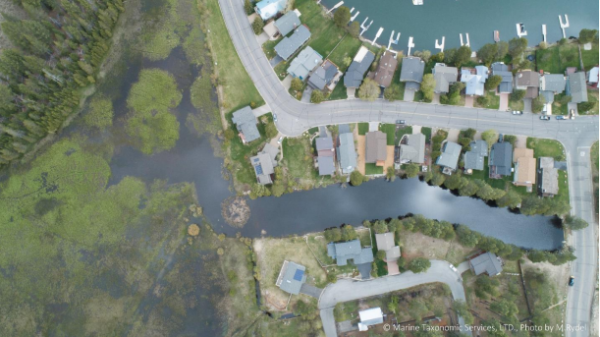
Everything is connected, but some things are better off kept apart. Such is the case with Pope Marsh and neighboring water sources.
Pope Marsh acts as a natural filter for water reaching Lake Tahoe and provides habitat for such species as bears, beavers, and sandhill cranes. In recent years, aquatic invasive plants like Eurasian watermilfoil and curlyleaf pondweed have infiltrated the marsh, choking out native species, clogging the wetlands, and hindering natural filtration. An initial investment of $75,000 from the Tahoe Fund and $180,000 from the Lake Tahoe Invasive Species Program went a long way toward removing these overabundant weeds, but biologists were left with one last problem to solve.
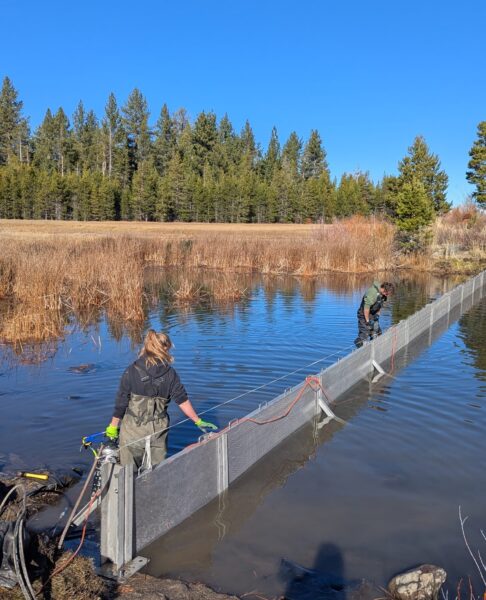
Workers install a metal screen to prevent invasive plant fragments from reaching Pope Marsh. Photo: Marine Taxonomic Services, an N|V|5 Company.
The Tahoe Keys lagoons and Lake Tallac are notorious source waters for invasive species, from clingy plants to released pet goldfish. Eurasian watermilfoil can reproduce from a single fragment, rapidly establishing new populations, including areas where control work has taken place. At the interface of Lake Tallac and Pope Marsh, escaped flowing fragments hinder ongoing restoration work in the marsh. A 1970s low-level concrete dam, known as a weir, was not sufficient to keep the invaders at bay.
To protect the investments in the marsh, Lake Tahoe Invasive Species Program partners, Tahoe Resource Conservation District (Tahoe RCD), Tahoe Regional Planning Agency (TRPA), Marine Taxonomic Services, Ltd. (MTS) an N|V|5 Company, and the Tahoe Keys Property Owners Association (TKPOA), collaborated to contain the aquatic invaders and protect Pope Marsh.
The solution was simple yet effective: a screening barrier between the waterbodies. Designed to withstand bear activity, busy beavers, and high flows, the metal screen separates Lake Tallac and the critical wetland habitat. Holes in stainless steel keep water moving while trapping problematic fragments.
MTS designed and directed the fabrication of custom metal panels in coordination with Tahoe RCD, following approval from the property owner’s association. TRPA purchased the materials, and MTS divers installed the new barrier in November 2025.
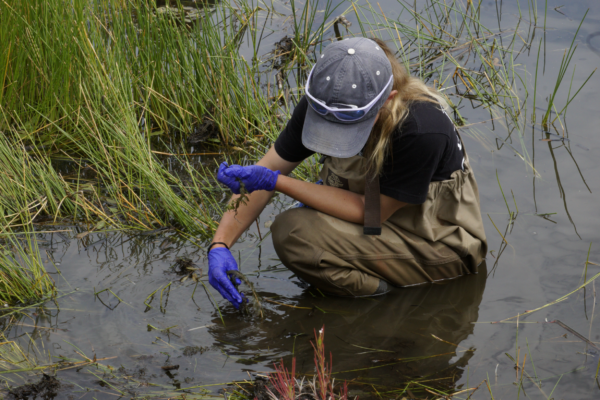
A crew member removes weed fragments in the area prior to installation. During the 2025 season, Marine Taxonomic Services divers removed 4,860 individual plants, 4,100 gallons of aquatic invasive plants, and 10,400 fragments from Pope Marsh. The screen assists in controlling efforts to protect Pope Marsh.
The new metal screen provides sustainable protection for the investments in Pope Marsh. MTS divers removed 4,100 gallons of plant matter and 10,400 fragments from Pope Marsh in the 2025 field season. With the completion of the weir screen, fragments from Lake Tallac are prevented from reinfesting the restoration area.
TKPOA currently provides monitoring and maintenance of the weir screen, including removing trapped plant fragments. They have already invested in two custom replacements to ensure the barriers continue to protect the marsh.
“We’re excited to be a part of the solution for protecting Pope Marsh from AIS,” says Peter Grant, a TKPOA board member. “Our board is aligned and committed to preserving the beauty of this very special place. The establishment of this weir screen provides a significant solution to containing the weeds at this critical juncture of Lake Tallac and Pope Marsh and allows us to focus on our next steps for weeds containment.”
For more information about Pope Marsh and other aquatic invasive species work around the Tahoe Basin, visit restoretahoe.org.
McKenzie Koch is the AIS outreach and education specialist at TRPA.

Click here to read more articles from the 32nd issue of TRPA’s environmental newspaper, including updates to forest health standards, the comeback of gray wolves in the Sierra Nevada, and the historic Fanny Bridge replacement project in Tahoe City.